Table Of Contents
Redesign projects represent pivotal moments for businesses seeking to refresh their digital presence, strengthen their brand identity, or adapt to evolving market demands. Unlike starting from scratch, redesign work requires careful consideration of existing assets, user expectations, and business objectives whilst simultaneously introducing innovation and improvement. The difference between a successful redesign and a costly misstep often comes down to strategic planning, stakeholder alignment, and a methodical approach to implementation. This comprehensive guide walks you through the essential steps to approach redesign projects with confidence and set yourself up for measurable success.
Establish Clear Objectives and Success Metrics
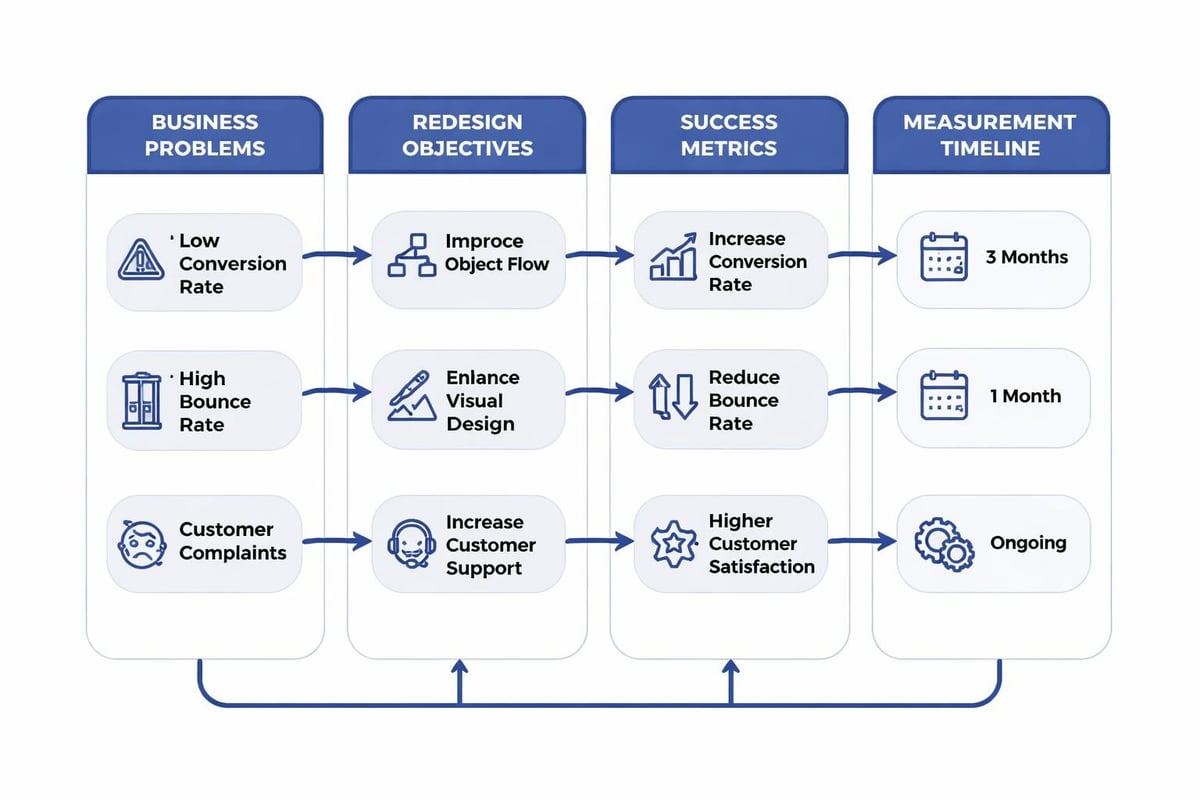
Before touching a single design element, you must define what success looks like for your redesign project. This foundational step prevents scope creep, aligns stakeholders, and provides a framework for evaluating results.
Start by identifying the core problems you're solving. Are conversion rates declining? Has your brand become inconsistent across platforms? Is your current website failing accessibility standards? Document specific pain points with quantifiable data wherever possible.
Key objectives to consider:
- Increase conversion rates by a specific percentage
- Improve website load speed and performance metrics
- Enhance mobile user experience and responsiveness
- Strengthen brand consistency across all touchpoints
- Reduce bounce rates on critical landing pages
- Improve accessibility compliance and inclusivity
Once you've identified problems, translate them into measurable goals. Rather than vague aspirations like "improve user experience," set concrete targets such as "reduce checkout abandonment by 25% within three months of launch." These metrics will guide design decisions and provide accountability throughout the project lifecycle.
Create a success measurement framework that includes both quantitative and qualitative indicators. While analytics provide hard numbers, user feedback, stakeholder satisfaction, and brand perception offer valuable context that pure data cannot capture.
Conduct Comprehensive Research and Analysis
Research forms the backbone of informed redesign decisions. Starting with user data ensures you're designing for actual needs rather than assumptions or personal preferences.
Audit Your Current Assets
Begin with a thorough audit of existing materials. For web design projects, analyse your current site's performance using tools like Google Analytics, heat mapping software, and user session recordings. Document what's working well and what's failing.
| Audit Component | What to Examine | Tools to Use |
|---|---|---|
| Content | Engagement rates, outdated information, SEO performance | Google Analytics, Search Console |
| Design | Visual consistency, brand alignment, accessibility | Manual review, WAVE, Lighthouse |
| Technical | Load speed, mobile responsiveness, broken links | PageSpeed Insights, Mobile-Friendly Test |
| User Behaviour | Click patterns, drop-off points, navigation issues | Hotjar, Crazy Egg, FullStory |
For branding redesign projects, evaluate all brand touchpoints. Review your logo, colour palette, typography, messaging, photography style, and how these elements appear across different media. Identify inconsistencies that confuse audiences or dilute brand recognition.
Understand Your Users
User research reveals how real people interact with your current design and what they need from the redesign. Employ multiple research methods to build a complete picture:
- User interviews: Conduct one-on-one conversations to uncover motivations, frustrations, and expectations
- Surveys: Gather quantitative data from larger audience segments about preferences and pain points
- Usability testing: Watch users navigate your current design to identify friction points
- Analytics analysis: Study behavioural data to understand how users actually interact with your site
Recent research on Kansei Engineering in web design demonstrates how aligning design processes with user emotions significantly enhances user experience, particularly when redesigning for specific industries or audience segments.
Analyse Competitive Landscape
Study how competitors and industry leaders approach similar design challenges. This isn't about copying, but understanding market expectations and identifying opportunities for differentiation. Create a competitive analysis matrix comparing key features, design approaches, and user experience elements.
Look beyond direct competitors to aspirational brands in other industries. The best digital agency websites often incorporate innovative approaches that can inspire creative solutions for your own redesign projects.
Build a Strategic Project Framework
Organisation and planning separate successful redesign projects from chaotic ones. Establish a framework that provides structure whilst maintaining flexibility for creative exploration.
Define Scope and Deliverables
Create a detailed scope document that outlines exactly what the redesign encompasses. Be explicit about what's included and, equally importantly, what's excluded. This prevents misunderstandings and manages expectations across all stakeholders.
Essential scope elements:
- Specific pages, sections, or components being redesigned
- New features or functionality being added
- Content creation or migration requirements
- Technical integrations or platform changes
- Testing and quality assurance processes
- Post-launch support and maintenance
Avoiding common pitfalls in website redesign projects requires establishing internal ownership and involving stakeholders early in the process, ensuring everyone understands the scope and their responsibilities.
Establish Timeline and Milestones
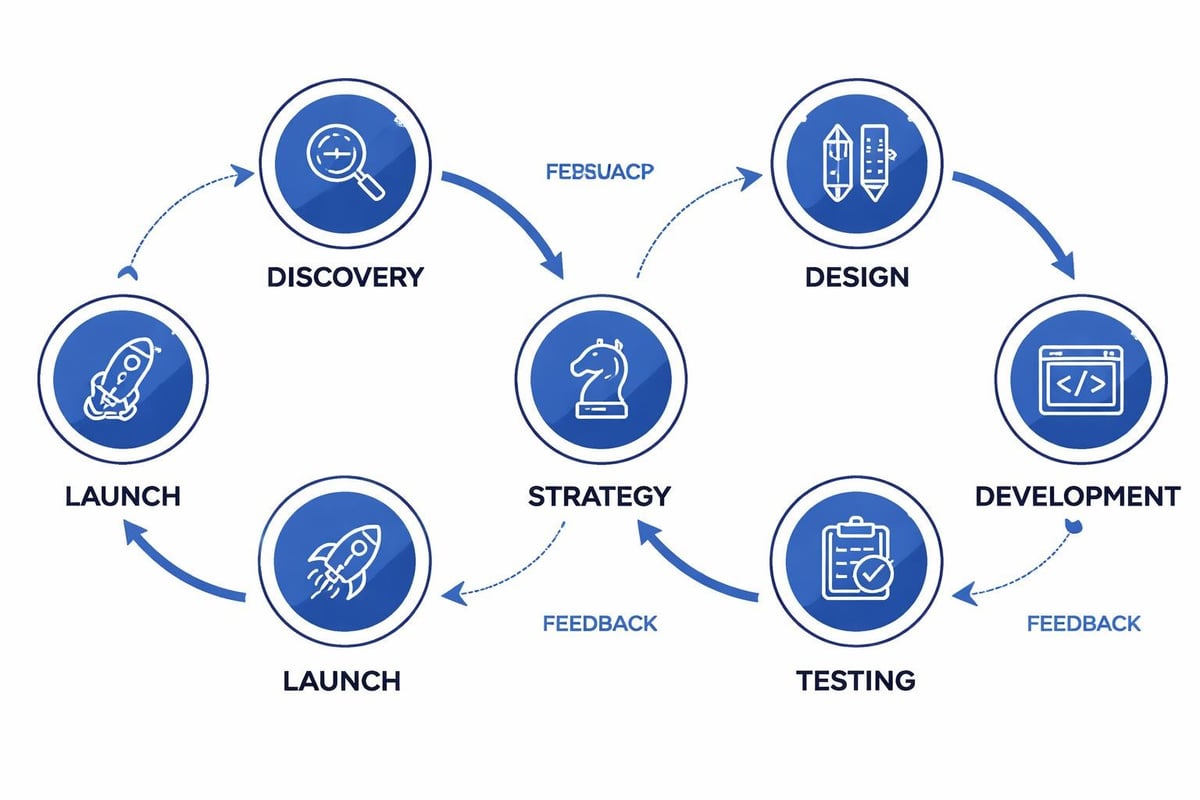
Break the redesign project into distinct phases with clear milestones. This creates accountability, allows for progress tracking, and provides natural checkpoints for stakeholder review and feedback.
A typical redesign timeline includes:
- Discovery phase (1-2 weeks): Research, audits, stakeholder interviews
- Strategy development (1 week): Define objectives, create project brief
- Design exploration (2-3 weeks): Mood boards, concepts, initial designs
- Design refinement (2-3 weeks): Iterations based on feedback
- Development (3-6 weeks): Build, integrate, populate content
- Testing (1-2 weeks): Quality assurance, user testing, refinements
- Launch preparation (1 week): Final checks, deployment planning
- Post-launch monitoring (ongoing): Performance tracking, optimisation
Adjust these timeframes based on project complexity, but avoid the temptation to rush. Budgeting sufficient time ensures quality outcomes and reduces stress throughout the process.
Allocate Resources Appropriately
Identify the skills, tools, and budget required for successful execution. Redesign projects often require diverse expertise including strategy, design, development, content creation, and project management.
Consider whether to handle work internally, partner with specialists, or adopt a hybrid approach. For businesses without in-house design capabilities, working with experienced professionals who understand the nuances of redesign projects ensures superior results and avoids costly mistakes.
Engage Stakeholders Throughout the Process
Stakeholder management makes or breaks redesign projects. The most brilliant design fails if key decision-makers feel excluded or surprised by the direction.
Identify All Stakeholders
Map everyone with a vested interest in the redesign outcome. This extends beyond obvious executives to include department heads whose teams use the asset, customer service representatives who field complaints, and sales teams who rely on materials to close deals.
Create a stakeholder matrix categorising individuals by their level of influence and interest. High-influence, high-interest stakeholders require close collaboration and frequent updates. Low-influence, high-interest stakeholders need regular information but less intensive involvement.
Create Feedback Mechanisms
Establish clear processes for gathering and incorporating stakeholder input. Schedule regular review sessions at key milestones rather than ad-hoc meetings that disrupt workflow and create confusion.
Set expectations about feedback timing and format. Provide specific questions to focus stakeholder attention: "Does this colour palette align with our brand values?" rather than "What do you think?" Vague requests generate vague responses that don't move projects forward.
Implement a feedback consolidation process where one designated person synthesises input from multiple stakeholders. This prevents designers from receiving conflicting directions and ensures decisions align with overall project objectives.
Manage Expectations Realistically
Be transparent about constraints, trade-offs, and timelines. When stakeholders understand why certain approaches aren't feasible, they're more likely to support alternatives.
Educate non-designers about design principles and processes. When executives understand that effective design requires research, iteration, and testing rather than immediate perfection, they become more patient and supportive throughout the redesign journey.
Design with Purpose and Consistency
The actual design phase transforms research and strategy into tangible visual solutions. Approach this creatively whilst maintaining discipline around established objectives and brand guidelines.
Develop a Design System
Create or refine a design system that ensures consistency across all redesigned elements. This includes:
- Colour palette: Primary, secondary, and accent colours with specific hex codes
- Typography: Font families, sizes, weights, and hierarchy for different content types
- Spacing: Consistent margins, padding, and grid systems
- Components: Reusable elements like buttons, forms, cards, and navigation
- Imagery style: Photography treatment, illustration style, iconography
A robust design system accelerates execution, maintains consistency, and provides clear guidelines for future updates. Research on measuring website aesthetics demonstrates how colour harmony and typography choices significantly impact user perception and satisfaction.
Prioritise User Experience
Every design decision should enhance the user's ability to achieve their goals efficiently and enjoyably. Apply established UX principles while testing assumptions with real users.
Core UX considerations:
- Navigation clarity: Users should always know where they are and how to find what they need
- Content hierarchy: Important information receives visual prominence through size, colour, and placement
- Accessibility: Designs meet WCAG standards for colour contrast, keyboard navigation, and screen readers
- Mobile responsiveness: Experiences adapt gracefully across device sizes and capabilities
- Performance: Visual appeal never compromises load speed or functionality
Understanding how to make websites mobile-friendly has become non-negotiable as mobile traffic continues dominating web usage patterns in 2026.
Balance Innovation with Familiarity
Redesign projects walk a tightrope between refreshing outdated elements and maintaining enough familiarity that existing users don't feel disoriented. Dramatic changes can alienate loyal audiences whilst timid updates fail to achieve meaningful improvement.
Identify which elements define your brand identity and must remain recognisable, versus which aspects need significant evolution. For instance, you might modernise your logo whilst preserving distinctive brand colours that customers associate with your business.
Test major departures with user groups before committing. When graphic design changes significantly alter brand perception, gather feedback to ensure changes resonate positively with target audiences.
Test Rigorously Before Launch
Testing transforms good redesigns into great ones by catching issues before they impact real users and business outcomes.
Conduct Multiple Testing Types
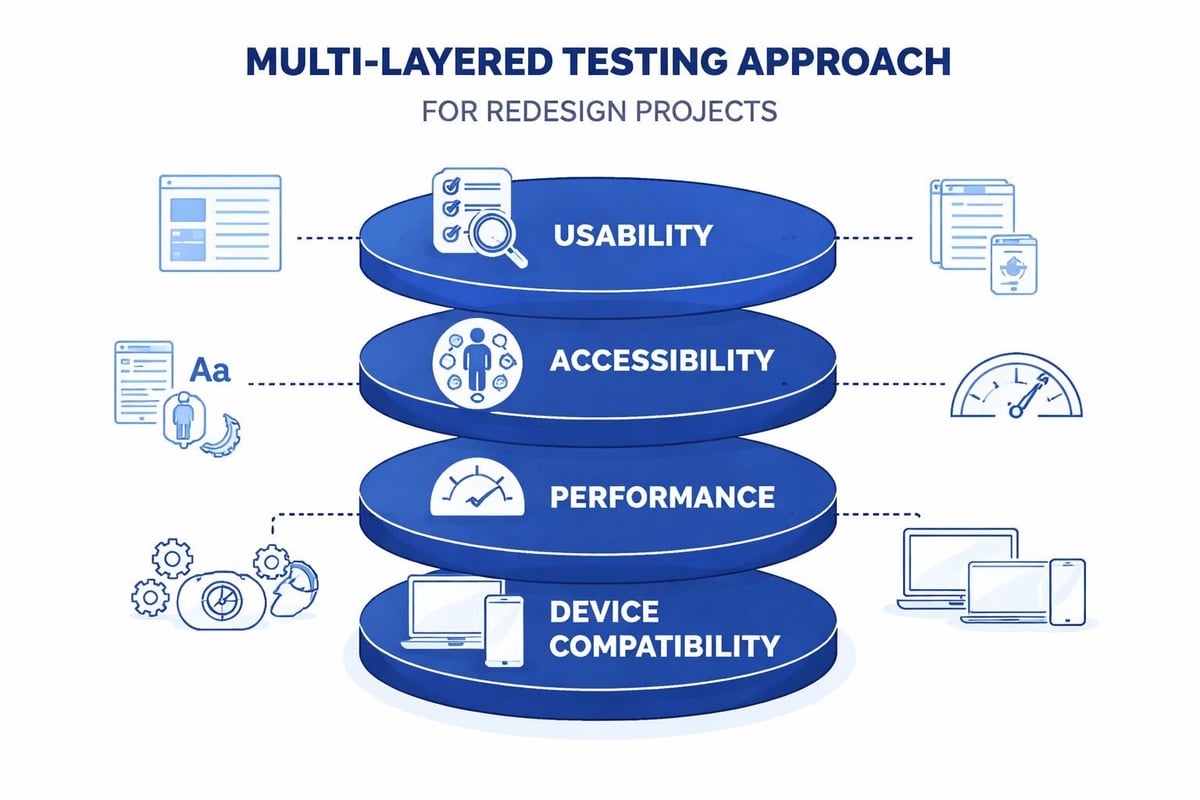
Layer different testing methodologies to catch various issue categories:
| Testing Type | Purpose | When to Conduct |
|---|---|---|
| Usability Testing | Validate that users can complete key tasks | Mid-design and pre-launch |
| A/B Testing | Compare design variations for effectiveness | During design phase for key decisions |
| Browser/Device Testing | Ensure consistent appearance and functionality | Final development phase |
| Accessibility Testing | Verify compliance with accessibility standards | Throughout design and development |
| Performance Testing | Confirm load speeds meet targets | Post-development, pre-launch |
| Content Review | Check copy accuracy, tone, and completeness | Final phase before deployment |
Don't skip testing due to timeline pressure. Automated approaches to repairing web pages can help optimise both usability and aesthetics, but human testing remains essential for catching nuanced issues that algorithms miss.
Create a Quality Assurance Checklist
Develop a comprehensive checklist covering all testing areas. Assign specific team members to verify each item and document results systematically.
Your QA checklist should include functional testing (all links work, forms submit correctly, interactive elements respond properly), visual testing (design matches specifications, images display correctly, typography renders as intended), and content testing (spelling and grammar are correct, information is accurate and current).
Plan for Iteration
Expect to discover issues requiring fixes and refinements. Build buffer time into your schedule for addressing test findings before launch. Prioritise issues by severity: critical bugs that prevent core functionality must be fixed immediately, whilst minor aesthetic tweaks can potentially be addressed post-launch.
Prepare for a Smooth Launch and Transition
Launch preparation determines whether your redesign debuts successfully or encounters preventable problems that damage credibility and user trust.
Develop a Launch Plan
Create a detailed launch sequence outlining exactly when and how the redesign goes live. Consider whether to launch everything simultaneously or phase implementation across sections, audiences, or features.
Launch plan components:
- Pre-launch tasks: Final backups, DNS preparation, staging environment verification
- Launch sequence: Step-by-step deployment process with assigned responsibilities
- Monitoring protocols: What metrics to watch and who watches them during initial hours
- Rollback procedures: How to revert if critical issues emerge immediately after launch
- Communication plan: When and how to announce the redesign to users, customers, and stakeholders
For website redesign projects specifically, following comprehensive planning guidelines helps ensure technical preparation matches creative excellence.
Communicate Changes to Users
Prepare your audience for the transition, especially when redesigns introduce significant changes to familiar interfaces or navigation patterns. Advance communication reduces confusion and demonstrates respect for user experience.
Consider creating:
- Announcement emails highlighting key improvements and new features
- Tutorial videos or help documentation for navigating major changes
- FAQ sections addressing anticipated questions about the redesign
- Social media posts building excitement about upcoming enhancements
Frame communications around user benefits rather than company preferences. "We've redesigned our checkout process to save you time" resonates more effectively than "We've updated our website."
Plan Post-Launch Monitoring
The first week after launch provides crucial data about how the redesign performs in real-world conditions. Establish monitoring systems that track both technical performance and user behaviour.
Monitor analytics closely for unexpected changes in conversion rates, bounce rates, or user flow patterns. Set up alerts for technical issues like server errors, broken links, or page load problems. Gather user feedback through surveys, support tickets, and social media monitoring.
Create a rapid response process for addressing issues quickly. Designate team members responsible for monitoring specific areas and establish clear escalation paths for different problem types.
Optimise Based on Real-World Performance
Launch marks the beginning, not the end, of your redesign project's impact. Continuous optimisation ensures sustained improvement and return on investment.
Analyse Performance Against Objectives
Return to the success metrics established at project outset. Compare actual performance against targets at regular intervals: one week post-launch, one month, three months, and six months.
Create performance dashboards that visualise key metrics for easy stakeholder communication. Understanding how to write website copy that converts becomes measurable when you track conversion rates before and after content redesigns.
Gather and Act on User Feedback
Systematically collect qualitative feedback from users experiencing the redesigned assets. Their perspectives reveal issues that analytics alone cannot surface, such as confusing messaging, missing information, or frustrating interaction patterns.
Implement feedback collection mechanisms including:
- In-app surveys: Short questionnaires triggered after specific user actions
- User interviews: Scheduled conversations with representative users about their experience
- Support ticket analysis: Pattern identification from customer service inquiries
- Social listening: Monitoring mentions and sentiment across social platforms
Prioritise feedback based on frequency, severity, and alignment with business objectives. Not all feedback warrants action, but patterns indicating widespread confusion or frustration demand attention.
Implement Continuous Improvements
Treat your redesign as a foundation for ongoing enhancement rather than a finished product. Schedule regular review cycles to assess performance, identify optimisation opportunities, and implement refinements.
Small, data-driven adjustments compound over time to produce significant improvements. A/B test variations of key elements, refine content based on user behaviour, and adapt to emerging technologies or user expectations.
Document changes and their impacts to build institutional knowledge. This record proves invaluable for future redesign projects and helps justify continued investment in design excellence.
Successful redesign projects balance strategic planning, user-centered design, rigorous testing, and continuous optimisation to deliver meaningful improvements that drive business results. Whether you're refreshing your website, revitalising your brand identity, or updating marketing materials, the methodical approach outlined in this guide provides a framework for achieving your objectives whilst managing complexity and stakeholder expectations. Cam Gomersall Design brings over 10 years of experience to redesign projects, combining comprehensive brand strategy with expert execution across web design, branding, and digital solutions to help businesses transform their visual presence and achieve measurable growth.