Table Of Contents
The intersection of UX and marketing is where businesses win or lose customer loyalty and growth.
Digital experience has never been more critical, and brands must master both fields to stand out.
This guide empowers you with proven strategies to unite UX and marketing for better engagement, conversions, and long-term brand success. You will discover actionable steps, methodologies, and expert insights to thrive in the evolving digital landscape.
Explore how these disciplines align, clash, and ultimately drive results. Get ready for a roadmap packed with practical tactics, real-world examples, and the tools you need to future-proof your approach.
Understanding UX and Marketing in 2026
In 2026, UX and marketing are more interconnected than ever. As digital experiences become richer and more complex, businesses must align these disciplines to create seamless, engaging journeys across every touchpoint. Understanding how user experience and marketing have evolved sets the foundation for future growth.
Defining UX and Marketing: Evolving Roles
UX and marketing have both undergone significant transformation in the digital era. Today, ux and marketing each focus on the user, but their approaches differ. UX is all about usability, satisfaction, and emotional connection, ensuring that every interaction is intuitive and meaningful. Marketing, on the other hand, is dedicated to communicating value, driving engagement, and ultimately converting users into loyal customers.
Both fields now extend across a growing array of touchpoints. In 2026, the customer journey includes AI-powered chatbots, smart devices, mobile apps, interactive emails, and even physical experiences integrated with digital platforms. UX must account for every one of these moments, while marketing ensures that messaging and branding remain consistent throughout.
To illustrate, consider the Oura Ring. A user might first encounter this wellness device through a targeted Instagram ad. From there, a frictionless transition leads them to a personalised landing page, then a streamlined checkout, all designed to minimise barriers and maximise satisfaction. This journey is a prime example of how ux and marketing can work in harmony.
Here is a table summarising the core differences and overlaps:
The shift towards data-driven, personalised, and empathetic strategies is evident in both domains. UX leverages insights to improve satisfaction, while marketing uses the same data to tailor campaigns for greater impact. As a result, ux and marketing are converging, with success depending on their ability to collaborate seamlessly.
Key Trends Shaping UX and Marketing
Several trends are shaping the future in 2026. First, artificial intelligence and automation are driving hyper-personalisation, allowing brands to anticipate user needs in real time. AI-powered interfaces adapt content, layout, and recommendations for each individual, creating a sense of relevance and care.
Accessibility and inclusivity have become non-negotiable. Ethical design is now a baseline expectation, with users demanding fair, transparent experiences. Instant, frictionless interactions are the norm, and brands that cannot deliver risk losing engagement quickly.
Consider these leading trends:
- AI-driven personalisation and journey mapping.
- Accessibility and ethical design at every stage.
- Seamless omnichannel experiences, both online and offline.
- Convergence of qualitative (interviews, feedback) and quantitative (analytics, heatmaps) research for deeper user understanding.
Brands embracing these trends see measurable benefits. For example, those with seamless ux and marketing integration report higher engagement and retention rates than competitors. As digital ecosystems become more complex, the ability to merge UX insights with marketing strategies is a key differentiator.
To stay ahead, professionals must keep up with innovations like AI-powered UX design trends, which highlight the importance of autonomous optimisation and self-improving interfaces. This continuous evolution ensures that ux and marketing remain at the forefront of business growth.
In summary, the intersection of UX and marketing in 2026 is defined by technology, empathy, and cross-disciplinary collaboration. Businesses that master these changes will drive stronger engagement, higher conversions, and lasting brand loyalty.
The Synergy and Tensions Between UX and Marketing
In 2026, the relationship between UX and marketing is more intertwined than ever. Businesses depend on both disciplines to deliver value, build trust, and drive growth. Yet, while they share many objectives, their approaches can sometimes pull in different directions.
Where UX and Marketing Align
At their core, UX and marketing both strive to create meaningful experiences that attract and retain customers. Each discipline relies on deep user understanding, using interviews, surveys, and data to inform strategy.
Both teams develop personas to guide decisions. While UX may focus on the end user's needs, marketing often targets the buyer or decision-maker. Despite this, their research overlaps, especially in omnichannel journeys where a seamless experience is key.
Brand loyalty is another shared priority. UX builds trust through intuitive interfaces and consistent journeys, while marketing fosters loyalty with compelling messaging and incentives. For example, in an ed-tech app, UX might tailor the interface for students, while marketing crafts campaigns for parents and educators.
This alignment grows stronger as businesses move toward integrated, data-driven strategies. The combined focus on user satisfaction and value perception makes ux and marketing essential partners in shaping customer journeys.
Points of Conflict and Resolution
Despite shared goals, tensions arise when priorities clash. Marketing may push for aggressive tactics like popups or lead generation overlays, which can disrupt the seamless experience UX strives to provide. These tactics, while effective for short-term conversions, can frustrate users and damage brand perception.
Another challenge is when marketing objectives influence UX research. If user testing is steered by sales goals, results may become biased, reducing the validity of insights. Organisational structures can also contribute to tension, as marketing often leads planning cycles, leaving UX to adapt late in the process.
Poor collaboration leads to friction and inconsistent journeys, which hurt conversions. However, structured communication and clear role definitions can resolve many of these issues. Aligning KPIs ensures both teams are accountable for user satisfaction and business outcomes.
A practical resolution is to integrate disciplines through shared workshops, dashboards, and regular feedback. Effective copywriting is a powerful bridge between user experience and marketing, as discussed in How to Write Website Copy that Converts, showing that the right words and structure can support both user needs and marketing objectives.
Real-World Scenarios
Consider an ecommerce site where marketing deploys popups to boost signups, while UX advocates for a streamlined checkout. If not balanced, this can annoy users and increase abandonment. By reviewing analytics and user feedback together, teams can find a compromise, such as time-delayed popups or context-aware offers.
Focus groups present another challenge. What users say in a group may not reflect their true behaviour, leading to groupthink or loss of context. Observing real user actions through usability testing provides more accurate insights for both ux and marketing.
Ultimately, success depends on prioritising real user behaviour and iterative testing. Teams that collaborate effectively, using both qualitative and quantitative data, can optimise every touchpoint. This synergy leads to higher satisfaction and stronger business results, proving the value of unified ux and marketing strategies.
Strategies for Effective Collaboration in 2026
Effective collaboration between ux and marketing is the foundation for digital success in 2026. As businesses strive to meet rising customer expectations, uniting these disciplines ensures every touchpoint is optimised for both engagement and conversion. Let’s explore actionable strategies that help teams break silos, share insights, and drive measurable growth together.
Building Cross-Functional Teams and Communication
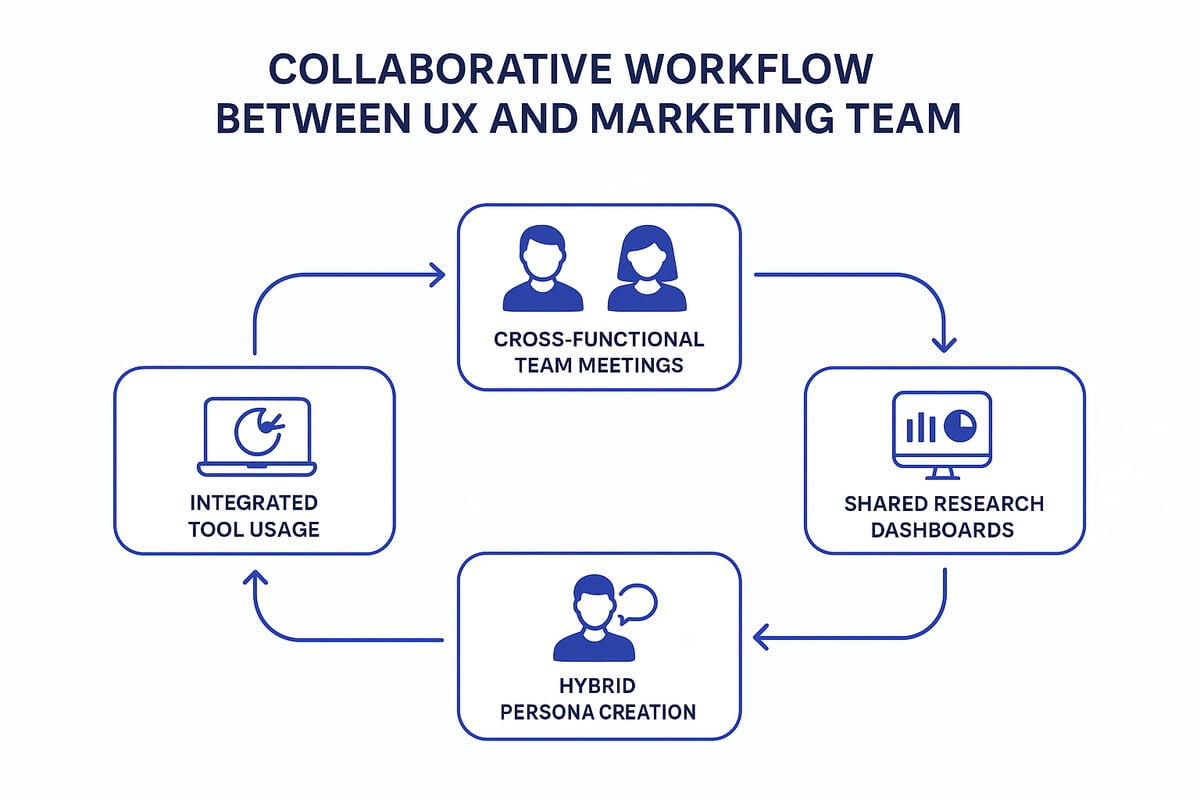
The most successful businesses in 2026 foster regular, structured communication between user experience and marketing teams. Monthly meetings create space for updates, campaign alignment, and sharing of research findings. Teams should prioritise transparency and encourage open dialogue about priorities and workflows.
Key practices include:
- Rotating team leads for meetings
- Shared agendas and collaborative note-taking
- Cross-training sessions to demystify each discipline
When both sides understand each other’s goals, collaboration becomes second nature, and friction is minimised. This approach also helps build trust and ensures that user needs and marketing objectives are balanced.
Sharing Research and Insights
Sharing research is essential for aligning UX teams with marketing strategies.
Marketing teams often gather market trends and buyer data, while UX brings usability findings and direct user feedback. Centralising this information on a shared dashboard or intranet ensures everyone has access to insights.
For example, after a major campaign launch, usability tests can reveal how real users interact with new messaging or features. This feedback loop helps both teams refine their approaches, leading to campaigns that resonate and experiences that convert.
Designing Shared Personas and Journey Maps
Hybrid personas are powerful tools for bridging ux and marketing. By combining user and buyer data into a single profile, teams can visualise the full customer journey. Journey maps created collaboratively highlight touchpoints where marketing and UX intersect.
Maintaining both distinct and shared personas allows for nuanced strategies. For example, an ed-tech platform might map journeys for students (UX focus) and parents (marketing focus), then develop hybrid personas for joint initiatives. This ensures all critical needs are addressed.
Aligning KPIs and Success Metrics
To drive collaboration, ux and marketing must align on key performance indicators. Shared KPIs like conversion rates, retention, and user satisfaction incentivise both teams to work towards common outcomes.
A simple KPI alignment table:
Regularly reviewing these metrics keeps everyone accountable and motivated to collaborate.
Overcoming Organisational Barriers
Organisational silos can undermine the synergy of user experience and marketing. Building UX maturity within the company is key. Leadership should champion integrated workflows and support joint training.
Workshops and cross-disciplinary learning sessions foster mutual understanding. When teams see their shared impact on business goals, resistance to collaboration fades. Documented processes and clear role definitions also prevent overlap and confusion.
Tools and Technologies for Collaboration
Leveraging the right tools streamlines collaboration between marketing and UX.
Project management platforms like Asana and Trello provide visibility into ongoing tasks. Shared research tools such as HotJar and Microsoft Clarity enable both teams to analyse user behaviour and campaign effectiveness.
For foundational alignment, revisiting Web Design Best Practices can help both teams adopt principles that drive consistency and performance across all digital assets.
A sample toolset table:
These tools support real-time feedback and rapid iteration, essential for continuous improvement.
Case Study: Oura Ring’s Seamless UX-Marketing Integration
Oura Ring provides a standout example of how UX and marketing collaboration drives results. From the initial Instagram ad to the final checkout, every touchpoint is consistent in branding, messaging, and usability.
The teams worked together to anticipate user needs at each stage. Usability testing informed marketing content, while campaign data shaped product design decisions. This holistic approach led to a significant reduction in cart abandonment, proving the value of integrated efforts.
When UX and marketing operate as one, customers experience a journey that is not only seamless but also deeply engaging and persuasive.
Essential UX Methodologies for Marketers
Understanding and applying the right UX methodologies is now essential for marketers aiming to drive results in 2026. The convergence of UX and marketing demands a toolkit that combines user empathy, data, and experimentation. Below, we explore the most effective techniques for building campaigns and products that resonate.

Surveys and Feedback Loops
Surveys offer a scalable way to collect user insights that inform both UX and marketing strategies. Well-designed surveys uncover motivations, pain points, and expectations directly from your audience.
- Use clear, concise questions to avoid confusion.
- Prefer multiple-choice for quick responses, but include open-ended questions for deeper insights.
- Schedule surveys at key touch-points, such as after purchase or following onboarding.
Feedback loops are ongoing mechanisms, like in-app prompts or post-interaction emails, that keep communication channels open. By integrating survey data with analytics, marketers gain a holistic view of user needs, helping to refine messaging and product features.
Usability Testing and Observation
Usability testing involves watching real users interact with a website, app, or campaign asset. This hands-on approach helps identify friction points that can hinder the ux and marketing objectives.
- Conduct both moderated and unmoderated sessions for a balanced perspective.
- Observe where users struggle, hesitate, or drop off.
- Use findings to iterate and improve designs before full launch.
Observation provides context that numbers alone cannot. For example, marketers may notice users consistently skipping a key CTA, signalling a need for clearer messaging or improved design. Iterative testing ensures continuous optimisation of the user journey.
Persona and Empathy Mapping
Creating accurate personas is foundational for aligning ux and marketing efforts. Personas should be based on real data, not assumptions, and reflect both demographic and psychographic traits.
- Include goals, challenges, and preferred channels for each persona.
- Update personas regularly as audience segments evolve.
Empathy mapping goes a step further, helping teams visualise what users think, feel, say, and do. This process uncovers hidden frustrations and unmet needs, allowing marketers to tailor content and campaigns for maximum relevance. Mapping the customer journey for a new SaaS product, for example, often reveals insights that drive both design and communication improvements.
Eye-Tracking and Heatmaps
Eye-tracking and heatmap tools, such as HotJar or Microsoft Clarity, reveal where users focus their attention on a page. These insights are invaluable for refining the intersection of ux and marketing, as they directly impact conversion rates.
- Analyse which areas receive the most and least engagement.
- Optimise placement of CTAs, navigation, and key information based on visual attention.
Incorporating visual hierarchy in design further enhances user experience and marketing results, ensuring critical elements stand out and guide users toward desired actions. Iterating based on heatmap data can lead to significant improvements in landing page effectiveness.
A/B Testing and Experimentation
A/B testing is a powerful methodology for validating design and content decisions in the context of ux and marketing. By systematically comparing two or more variations, marketers can identify what resonates best with different audience segments.
- Test headlines, images, CTAs, and layouts.
- Segment audiences to uncover preferences by demographic or behaviour.
- Measure results using clear, shared KPIs.
Experimentation should be continuous, not a one-off activity. Regularly testing ideas ensures marketing messages and user experiences stay relevant and effective, driving incremental gains in engagement and conversions.
Integrating Qualitative and Quantitative Data
The best ux and marketing strategies combine the power of numbers with the richness of human feedback. Analytics provide the "what," while interviews and open-ended surveys reveal the "why."
- Use analytics to spot trends and problem areas in user behaviour.
- Conduct interviews or usability sessions to understand motivations and emotions.
- Merge data sources for a comprehensive perspective.
For example, if heatmaps show users abandoning a checkout page, follow-up interviews might reveal issues with trust signals or confusing copy. This integrated approach leads to smarter, more empathetic optimisation across all touchpoints.
Optimising Key Touchpoints Across the User Journey
Every interaction a customer has with your brand is an opportunity to reinforce trust and drive results. For effective marketing and UX, optimising each touchpoint is essential. By refining the journey from discovery to retention, you set the stage for higher engagement and lasting loyalty.
Search Engines: First Impressions Matter
Your presence on search engines is often the first chance to impress. For ux and marketing teams, crafting meta titles and descriptions that are both compelling and relevant is crucial. This ensures users are enticed to click and that their expectations are met on arrival.
- Use clear, benefit-driven meta descriptions.
- Optimise landing pages to match search intent.
- Ensure fast loading speeds and mobile responsiveness.
A successful ux and marketing strategy ensures that searchers find what they need immediately, reducing bounce rates and increasing engagement. When meta information and on-page messaging align, users feel confident to take the next step.
Social Media: Consistency and Continuity
Social media is a dynamic space where ux and marketing must work hand in hand. Consistency in branding, language, and calls to action across ads and organic posts reassures users as they transition from social platforms to your website.
The rise of AI-driven tools enables hyper-personalised journeys, making every interaction feel tailored. Explore how Hyper-Personalized UX Experiences are shaping the future of social engagement, ensuring continuity and intent-aware design.
A seamless handoff from social media to landing pages is vital for maintaining trust and driving conversions in any modern ux and marketing approach.
Landing Pages: Clarity and Focus
Landing pages are where attention either converts or dissipates. For optimal ux and marketing results, clarity and focus are non-negotiable. Present a single, strong value proposition above the fold. Use concise copy and a prominent call to action.
- Limit distractions by reducing unnecessary links.
- Use visuals that reinforce your message.
- Test different layouts through A/B testing for incremental gains.
Every element should guide visitors toward your conversion goal. The right balance of persuasive marketing and user-centric design minimises friction and drives results.
Checkout Process: Removing Friction
The checkout process is a critical moment in the user journey. Even small obstacles can lead to abandonment. To optimise for both ux and marketing, provide guest checkout, display clear pricing, and offer multiple payment options.
Trust signals, such as security badges and transparent policies, alleviate concerns. Address common triggers like hidden fees or lengthy forms. A streamlined process not only improves conversion rates but also enhances brand perception.
When ux and marketing collaborate to simplify checkout, the impact on revenue and customer satisfaction is measurable.
Post-Purchase and Retention Touch-points
The journey does not end at the sale. Post-purchase experiences are vital for retention and advocacy. Follow-up emails, onboarding flows, and accessible support channels are all part of the integrated ux and marketing ecosystem.
Soliciting feedback through surveys or support interactions uncovers opportunities for continuous improvement. Proactive communication anticipates user needs and drives loyalty.
By closing the loop at every stage, a well-aligned ux and marketing strategy turns one-time buyers into long-term advocates.
Continuous Improvement: Data, Feedback, and Iteration
Continuous improvement lies at the heart of successful ux and marketing strategies. In 2026, brands that embrace a culture of ongoing learning and adaptation will outperform those that rely on assumptions or static processes.
Removing the Guesswork with Qualitative Insights
To move beyond guesswork, teams must dig deeper than analytics alone. Qualitative insights reveal the motivations, frustrations, and real behaviours that numbers cannot show.
Techniques such as user interviews, open-ended surveys, and session recordings provide context and nuance. For example, a SaaS company might discover through interviews that users abandon onboarding due to unclear instructions, a detail missed by analytics alone.
Integrating qualitative research into ux and marketing not only clarifies the "why" behind user actions but also uncovers hidden obstacles and opportunities.
Iterative Design and Experimentation
Continuous improvement requires a commitment to iterative design and experimentation. Rather than launching campaigns or features and moving on, successful teams test, refine, and optimise at every stage.
Regular A/B testing, usability studies, and rapid prototyping help teams validate assumptions and spot issues early. Brands that embed iteration into their ux and marketing processes see measurable gains in engagement and satisfaction.
This approach ensures changes are informed by real user feedback, not guesswork, and builds a foundation for long-term growth.
Bridging the Gap Between Data and Human Experience
Effective strategies balance hard data with human insight. Quantitative metrics like conversion rates are vital, but they should guide, not dictate, decisions.
Empathy mapping and persona development help teams interpret data through the lens of real user needs. For instance, adjusting messaging based on customer feedback, rather than click rates alone, leads to more authentic connections.
By merging data-driven thinking with empathy, brands create experiences that resonate and drive loyalty.
Future-Proofing Strategies
With technology evolving rapidly, future-proofing is essential for sustained UX and marketing success. Staying agile means regularly monitoring trends, investing in cross-disciplinary training, and preparing for emerging channels like voice, AR, and agentic AI.
The rise of AI-driven tools is reshaping how teams anticipate and respond to user needs. Brands can explore new possibilities by learning from resources such as Agentic AI in UX Design to stay ahead of industry shifts.
This proactive approach ensures teams are ready for whatever the future brings.
Expert Perspectives and Industry Examples
Leading brands demonstrate that integrated marketing and UX strategies drive superior outcomes. For example, companies that foster collaboration between UX designers and marketers consistently outperform competitors in retention and revenue.
Industry experts recommend establishing feedback loops, sharing insights across teams, and setting shared KPIs. For more actionable advice, explore Marketing Tips and Strategies to further enhance your approach.
By learning from proven examples and expert insights, businesses can confidently navigate the evolving digital landscape.
Now that you’ve explored how UX and marketing will work hand-in-hand in 2026, you can see just how much impact a seamless digital experience has on business growth and customer loyalty. If you’re ready to transform your brand with a strategy that brings UX and marketing together, let’s take the next step. With over a decade of experience helping businesses grow, I can help you create a digital presence that truly stands out and converts.
Feel free to Schedule a chat and let’s discuss how we can put these strategies into action for your business.