Table Of Contents
An ad agencies logo serves as the cornerstone of brand identity in the competitive creative services landscape. For agencies that help clients build powerful brands, their own visual identity must demonstrate exceptional design capability, strategic thinking, and creative excellence. In 2026, the expectations for agency branding have evolved beyond simple aesthetics to encompass dynamic systems, strategic positioning, and adaptability across digital platforms. The logo becomes the first conversation starter, the initial proof point of an agency's design prowess, and a critical factor in winning new business.
The Strategic Importance of Agency Logos
The ad agencies logo functions differently from typical corporate branding. While most businesses use logos to communicate stability and trust, creative agencies must balance professionalism with innovation. This dual requirement creates unique design challenges that separate exceptional agency identities from forgettable ones.
Agencies face intense scrutiny when potential clients evaluate their branding. Decision-makers inherently question how an agency can elevate their brand if the agency's own identity appears generic or outdated. This scrutiny extends beyond the logo itself to encompass the entire brand ecosystem, including websites, proposals, and social media presence.
Building Credibility Through Design Excellence
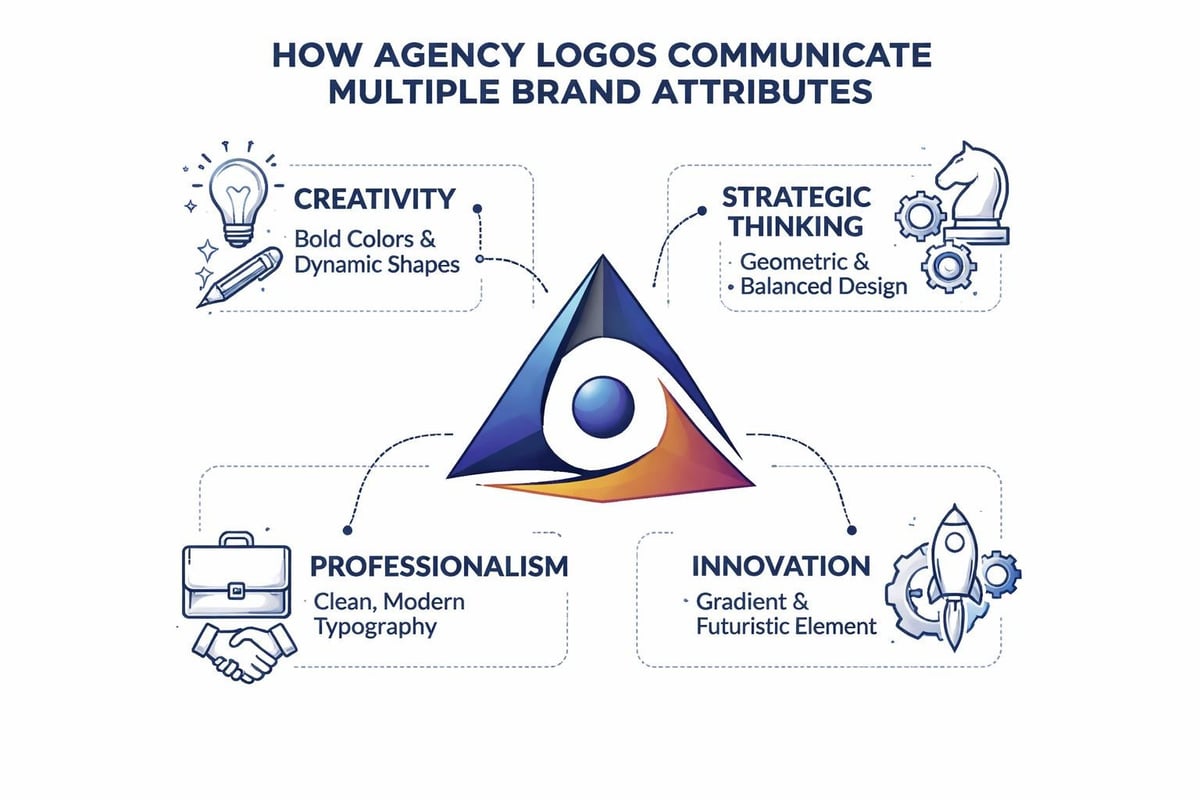
A well-crafted ad agencies logo immediately establishes credibility in client conversations. When prospects research potential agency partners, they assess visual identity as evidence of design capabilities and strategic thinking. Agencies with strong, memorable logos demonstrate their ability to solve complex branding challenges.
Key credibility factors include:
- Originality that avoids design clichés and trending styles
- Professional execution across all brand touchpoints
- Strategic alignment with agency positioning and values
- Versatility for various media and applications
- Memorability that makes the agency top-of-mind
The most successful creative agency logos demonstrate clear strategic positioning while maintaining visual appeal and functionality.
Current Trends Shaping Agency Identities
The landscape of logo design continues to evolve, with 2026 bringing fresh perspectives on how agencies present themselves visually. Understanding these trends helps agencies create identities that feel contemporary without appearing derivative or following fleeting fashions.
Logo design trends for 2026 emphasize dynamic identities that adapt to context while maintaining brand recognition. This shift reflects the increasingly complex digital ecosystem where brands appear across numerous platforms, devices, and contexts.
Dynamic and Adaptive Systems
Traditional static logos are giving way to flexible design systems that maintain consistency while allowing contextual variation. An ad agencies logo might incorporate different configurations, color treatments, or animations depending on where and how it appears.
| Trend Category | Application | Benefits |
|---|---|---|
| Dynamic Identities | Logo adapts to platform and context | Increased engagement, modern appeal |
| Minimalist Approaches | Simplified forms, reduced elements | Better scalability, clearer communication |
| Custom Typography | Bespoke letterforms and typefaces | Unique differentiation, brand ownership |
| Geometric Precision | Mathematical shapes and structures | Professional appearance, versatility |
These approaches allow agencies to demonstrate sophistication in brand strategy while creating visually striking identities. The best implementations balance innovation with practical functionality across all brand applications.
Material and Dimensional Design
Three-dimensional and tactile design elements have gained prominence as agencies seek to create more engaging visual experiences. The ad agencies logo might incorporate depth, shadow, or gradient effects that add richness without sacrificing clarity. Modern logo trends emphasize bold colors and gradients to create dynamic, eye-catching identities.
Dimensional design considerations:
- Ensure 3D effects don't compromise legibility at small sizes
- Create flat versions for situations requiring simplified reproduction
- Use depth strategically to highlight key brand elements
- Test dimensional logos across digital and physical applications
- Maintain brand recognition when removing dimensional effects
Best Practices for Agency Logo Development
Creating an effective ad agencies logo requires methodical approach combining creative exploration with strategic discipline. The process extends beyond aesthetic preferences to encompass competitive analysis, brand positioning, and functional requirements.
Research and Strategic Foundation
Before beginning design exploration, agencies must establish clear strategic parameters. This foundation ensures the logo accurately represents the agency's positioning, values, and target audience. Without this groundwork, design decisions become arbitrary rather than strategic.
Understanding competitive context proves essential for differentiation. Many agency logos fall into predictable patterns: abstract marks, lowercase sans-serif wordmarks, or minimalist geometric symbols. Breaking free from these conventions requires conscious effort and strategic justification.
The best practices for professional logo design emphasize uniqueness, scalability, and thorough competitive research as foundational elements of successful brand identities.
Design Exploration and Refinement
Professional logo development involves extensive exploration before settling on final directions. Agencies should generate numerous concepts exploring different strategic territories, visual approaches, and typographic treatments.
Exploration parameters include:
- Abstract symbols versus wordmarks versus combination marks
- Typography personality ranging from authoritative to playful
- Color strategies from monochromatic to vibrant multi-color
- Complexity levels from highly simplified to intricate detail
- Cultural considerations for global or local positioning
Each concept should represent distinct strategic territory rather than minor variations on single ideas. This breadth ensures the final selection represents truly optimal solution rather than first acceptable option.
Technical Considerations and Applications
An ad agencies logo must function flawlessly across unprecedented range of applications. Technical excellence separates professional identities from amateur efforts, demonstrating the agency's attention to detail and production standards.
Scalability and Reproduction
Modern logos appear everywhere from massive billboards to tiny favicon squares. The ad agencies logo must maintain integrity across this spectrum, remaining recognizable and attractive at any size.
| Size Range | Considerations | Testing Method |
|---|---|---|
| 16px - 64px | Simplified versions, clear spacing | Digital screens, favicons |
| 64px - 200px | Standard applications, full detail | Website headers, business cards |
| 200px+ | Full complexity, fine details | Large format printing, signage |
Professional logo design requires testing at every size to ensure consistent brand presentation regardless of application.
Color Systems and Flexibility
Strategic color application distinguishes sophisticated agency identities from basic logos. The ad agencies logo should incorporate primary brand colors while establishing complete color system including secondary palettes, tints, and application guidelines.
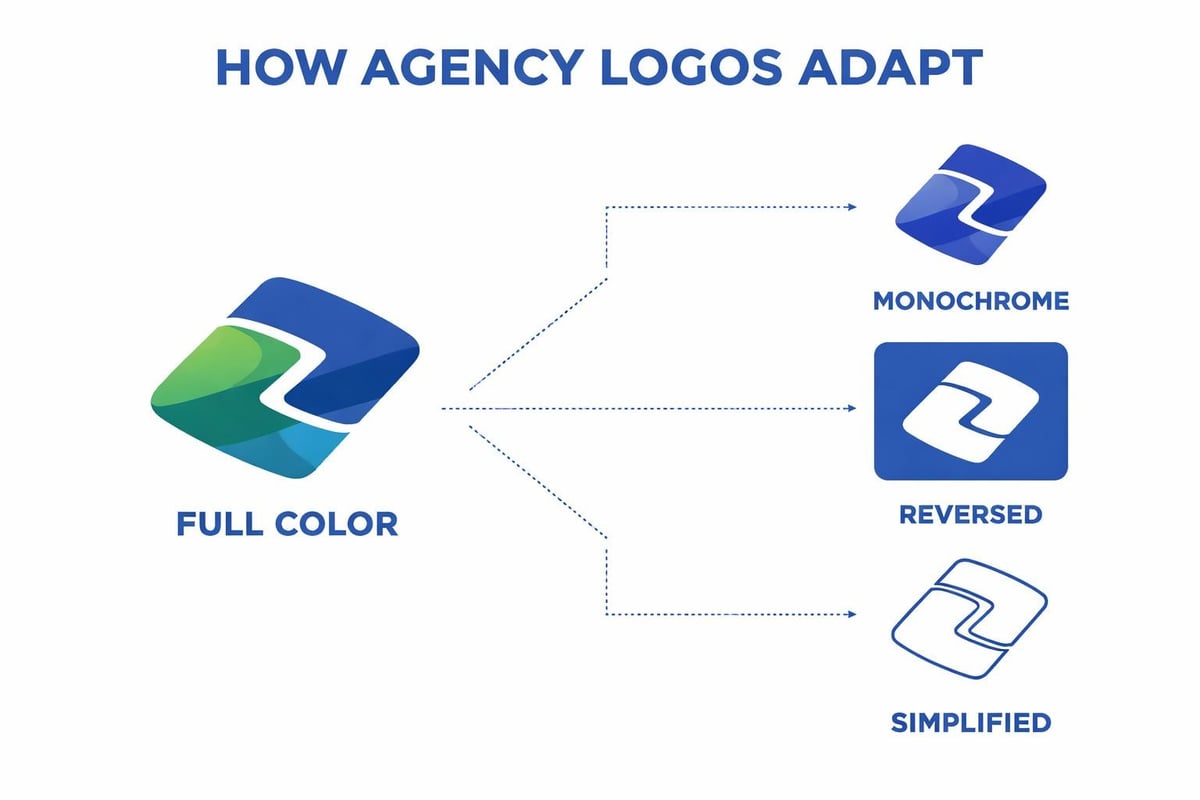
Color flexibility proves crucial for modern brand implementation. Agencies need versions optimized for light backgrounds, dark backgrounds, and colored environments. Single-color versions ensure reproduction on promotional products, stamps, and situations with color limitations.
Typography and Wordmark Development
Typography choices communicate tremendous information about agency personality and positioning. Whether the ad agencies logo relies primarily on custom letterforms or incorporates type as secondary element, typographic decisions require careful consideration and strategic alignment.
Custom Lettering Versus Typeface Selection
Agencies face fundamental choice between developing custom letterforms and selecting existing typefaces. Custom typography offers complete uniqueness and brand ownership but requires significant design investment and expertise.
Custom lettering advantages:
- Absolute uniqueness impossible to replicate
- Perfect alignment with brand personality
- Integration with symbolic elements
- Proprietary brand asset with long-term value
- Demonstration of design capabilities
Conversely, selecting existing typefaces provides access to professionally designed, extensively tested letterforms with complete character sets and weights. Many successful agency identities use carefully selected typefaces customized through subtle modifications.
Typographic Personality and Brand Alignment
Type selection must align with broader brand strategy and positioning. An agency specializing in corporate financial services requires different typographic personality than one focused on entertainment or lifestyle brands.
The best marketing agency logos demonstrate strategic typographic choices that reinforce agency positioning while maintaining professional credibility and visual interest.
Industry-Specific Considerations
Different agency specializations require tailored approaches to logo design. A digital advertising agency's identity differs substantially from traditional creative studio or specialized niche agency. Understanding these distinctions ensures the ad agencies logo communicates appropriate positioning.
Digital-First Agency Identities
Agencies operating primarily in digital spaces should ensure their logos excel in digital environments. This means optimization for screens, consideration of animation potential, and awareness of how the logo appears across social media platforms, websites, and digital advertising.
Digital optimization checklist:
- Test logo on various screen sizes and resolutions
- Develop animated versions for video and motion graphics
- Create social media profile variations for circular crops
- Ensure legibility on mobile devices and smartwatches
- Consider dark mode and light mode variations
These considerations prove especially relevant for agencies promoting their expertise in web design and development or digital marketing services.
Traditional and Integrated Agencies
Agencies offering comprehensive services spanning traditional and digital channels need logos functioning equally well in both environments. Print reproduction, physical signage, and dimensional applications require different considerations than purely digital identities.
The ad agencies logo for integrated shops must demonstrate versatility without appearing generic or uncommitted to particular expertise. This balance requires sophisticated design systems accommodating diverse applications while maintaining strong brand recognition.
Avoiding Common Design Pitfalls
Even experienced agencies sometimes create problematic identities for themselves. Understanding common mistakes helps avoid costly rebranding projects and ensures the ad agencies logo effectively supports business development.
Trend-Chasing and Design Fads
Following trending design styles creates immediate relevance but guarantees rapid obsolescence. Agencies particularly vulnerable to this pitfall since they remain acutely aware of current design trends and may overvalue contemporary aesthetics over timeless effectiveness.
| Common Pitfall | Why It Fails | Better Approach |
|---|---|---|
| Geometric minimalism clichés | Undifferentiated from competitors | Develop unique geometric language |
| Trendy color gradients | Quickly dates the identity | Use color strategically, not decoratively |
| Lowercase sans-serif wordmarks | Extremely common in agency space | Explore distinctive typography options |
| Abstract swoosh or arc symbols | Generic and forgettable | Create meaningful symbolic connections |
Practical logo design tips emphasize simplicity, timelessness, and uniqueness as antidotes to trend-chasing and derivative design.
Overcomplicating the Design
Agencies sometimes create overly complex logos attempting to communicate every service offering, value proposition, and differentiator simultaneously. This approach produces cluttered, confusing identities that fail at small sizes and overwhelm audiences.
The most effective ad agencies logo communicates primary brand essence with remarkable efficiency. Additional brand messaging belongs in supporting materials, websites, and comprehensive brand guidelines rather than compressed into logo design.
Integration With Broader Brand Systems
A logo never exists in isolation. The ad agencies logo forms one component within comprehensive brand system including typography, color palettes, graphic elements, photography styles, and tone of voice. Strategic integration across these elements creates cohesive brand experiences.
Visual Identity System Development
Professional agencies develop complete visual identity systems extending far beyond logo design. These systems provide frameworks for consistent brand application across unlimited touchpoints while allowing creative flexibility.
Essential system components:
- Primary and secondary logo variations
- Typography hierarchy and typeface selections
- Color systems including primary, secondary, and accent palettes
- Graphic elements and pattern libraries
- Photography and imagery guidelines
- Layout principles and composition rules
Understanding how brand identity and logo design work together creates stronger, more effective brand systems than treating the logo as standalone element.
Digital Brand Implementation
Modern brand systems must account for digital-first implementation across websites, social media, email marketing, and digital advertising. The ad agencies logo should integrate seamlessly with digital design patterns while maintaining strong recognition.
Agencies showcasing digital expertise through compelling website design demonstrate how logo and broader visual identity create cohesive digital brand experiences. This integration proves especially important for agencies positioning themselves as digital specialists.
Measuring Logo Effectiveness
Unlike many brand investments, logo effectiveness resists easy quantification. However, agencies can evaluate their identities through various qualitative and quantitative measures providing insights into brand performance.
Recognition and Recall Testing
Strong logos create immediate recognition and remain memorable after brief exposure. Testing logo recognition among target audiences reveals whether the design achieves these fundamental objectives. Low recognition scores indicate potential problems with distinctiveness or memorability.
Recall testing measures whether people remember the agency and its logo after seeing it previously. High recall demonstrates the logo effectively embeds itself in viewer memory, increasing likelihood of consideration during agency selection processes.
Competitive Differentiation Analysis
Effective ad agencies logo clearly differentiates from competitor identities. Side-by-side comparisons reveal whether the logo stands out in competitive context or blends into undifferentiated sea of similar designs.
This analysis extends beyond direct competitors to include broader creative services landscape. Agencies competing for similar clients should ensure their identities occupy distinct visual territories preventing confusion or generic positioning.
Evolution and Rebranding Considerations
Brand identities evolve as agencies grow, pivot, or expand service offerings. Understanding when and how to update the ad agencies logo prevents both premature changes and outdated identities that no longer serve business objectives.
Incremental Refinement Versus Complete Redesign
Most agencies benefit from incremental logo refinement rather than frequent complete redesigns. Subtle evolution maintains brand equity built over years while modernizing dated elements or improving functionality.
Refinement candidates include:
- Adjusting proportions for improved balance
- Refining typography spacing and letterforms
- Updating color values for better digital reproduction
- Simplifying overly complex elements
- Developing additional logo variations
Complete redesigns suit situations involving significant business changes: mergers, dramatic positioning shifts, or fundamentally flawed original designs. These circumstances justify brand equity sacrifice inherent in starting fresh.
Timing and Implementation Strategy
Logo changes require careful planning and phased implementation. Agencies should coordinate updates across all brand touchpoints systematically rather than creating confusing mixed periods with multiple logo versions simultaneously active.
Implementation typically proceeds from digital properties (easily updated) to physical materials (requiring production timing consideration) to large investments like signage or vehicle graphics (updated during normal replacement cycles). This approach minimizes waste while ensuring consistent brand presentation.
Industry Future and Emerging Approaches
The advertising agency landscape continues evolving with technological advancement, changing client expectations, and new service models. These shifts influence how agencies position themselves and express identity through logos and broader branding.
AI and Automated Design Tools
AI-generated logo concepts now provide rapid initial exploration, though professional refinement remains essential for distinctive, strategic identities. Agencies might leverage these tools for ideation while ensuring final designs demonstrate human creative judgment and strategic thinking.
The emergence of AI-driven advertising design tools influences broader agency operations and potentially affects how agencies position their creative services. Forward-thinking agencies incorporate these capabilities while maintaining emphasis on strategic counsel and creative excellence.
Sustainable and Ethical Design
Environmental consciousness and social responsibility increasingly influence brand development. Some agencies explicitly communicate these values through logo design choices, material specifications, and brand narratives emphasizing sustainability.
The ad agencies logo might incorporate elements signaling environmental commitment, though these expressions risk appearing superficial without supporting business practices. Authenticity remains paramount when branding around values-based positioning.
Case Studies and Learning From Successful Identities
Examining successful agency rebrands and new identity launches provides valuable insights into effective approaches, common patterns, and innovative solutions to familiar challenges.
Analyzing Top Performing Agency Logos
The most memorable ad agencies logo designs share characteristics transcending specific visual styles or aesthetic preferences. These patterns offer guidance for agencies developing or refining their own identities.
| Success Factor | Description | Example Applications |
|---|---|---|
| Strategic clarity | Logo clearly communicates positioning | Specialist agencies showing expertise area |
| Visual distinction | Stands apart from competitive set | Unique color choices, unexpected forms |
| Systematic flexibility | Works across all required contexts | Responsive logos, adaptive color systems |
| Timeless foundation | Avoids trend dependence | Classic typography, enduring symbols |
Learning from established agencies while developing original solutions creates identities benefiting from proven principles without derivative execution. The goal remains creating distinctly ownable brand expression rather than slight variation on familiar patterns.
An ad agencies logo represents far more than attractive visual mark. It communicates strategic positioning, demonstrates design capabilities, and creates foundation for comprehensive brand systems supporting business growth. By approaching logo development with strategic rigor, creative excellence, and technical precision, agencies create identities that attract ideal clients and differentiate in competitive markets. Whether you're launching a new agency or refining an established identity, investing in thoughtful, professionally executed branding pays dividends through stronger market position and client confidence. Cam Gomersall Design brings over a decade of experience creating distinctive brand identities and comprehensive design solutions that help agencies and businesses stand out, attract better clients, and build lasting market presence.