Table Of Contents
Creating a logo for a construction company requires more than aesthetic appeal. The systematic approach to logo design construction involves understanding structural principles, industry symbolism, and technical execution that ensures your brand stands out in a competitive market. Construction businesses need logos that communicate strength, reliability, and professionalism while remaining versatile across applications from hard hats to billboards. This comprehensive guide walks you through the essential steps and considerations for building a construction logo that works as hard as your business does.
Understanding Logo Design Construction Fundamentals
Logo design construction refers to the systematic, grid-based approach to creating logos that ensures mathematical precision, visual balance, and scalability. This methodology transforms abstract concepts into concrete visual identities through structured design principles.
The foundation of effective logo design construction lies in establishing a framework before adding creative elements. Professional designers use grid systems to create harmony and proportion, ensuring every curve, line, and angle serves a deliberate purpose. Using grids in logo design helps achieve the symmetry and balance that makes logos memorable and effective across all sizes.
Why Construction Companies Need Strategic Logo Design
Construction businesses face unique branding challenges. Your logo must work on everything from business cards to vehicle wraps, from safety helmets to website headers. The versatility required demands thoughtful logo design construction from the outset.
Key requirements for construction logos include:
- Clarity at small sizes (hard hats, tools)
- Bold visibility at large scales (billboards, building wraps)
- Professional appearance in single-color applications
- Durability across digital and physical mediums
- Instant industry recognition
A well-constructed logo builds trust before your first client meeting. Construction projects represent significant investments, and clients need confidence in your professionalism from first impression onward.
Step 1: Research Your Market Position
Before sketching a single line, comprehensive research forms the foundation of successful logo design construction. Understanding your competitive landscape, target audience, and industry positioning informs every design decision that follows.
Start by analyzing competitor logos in your geographic market and specialty areas. Document what works, what doesn't, and where opportunities exist for differentiation. Researching your competition reveals oversaturated visual themes you should avoid and underutilized concepts you can claim.
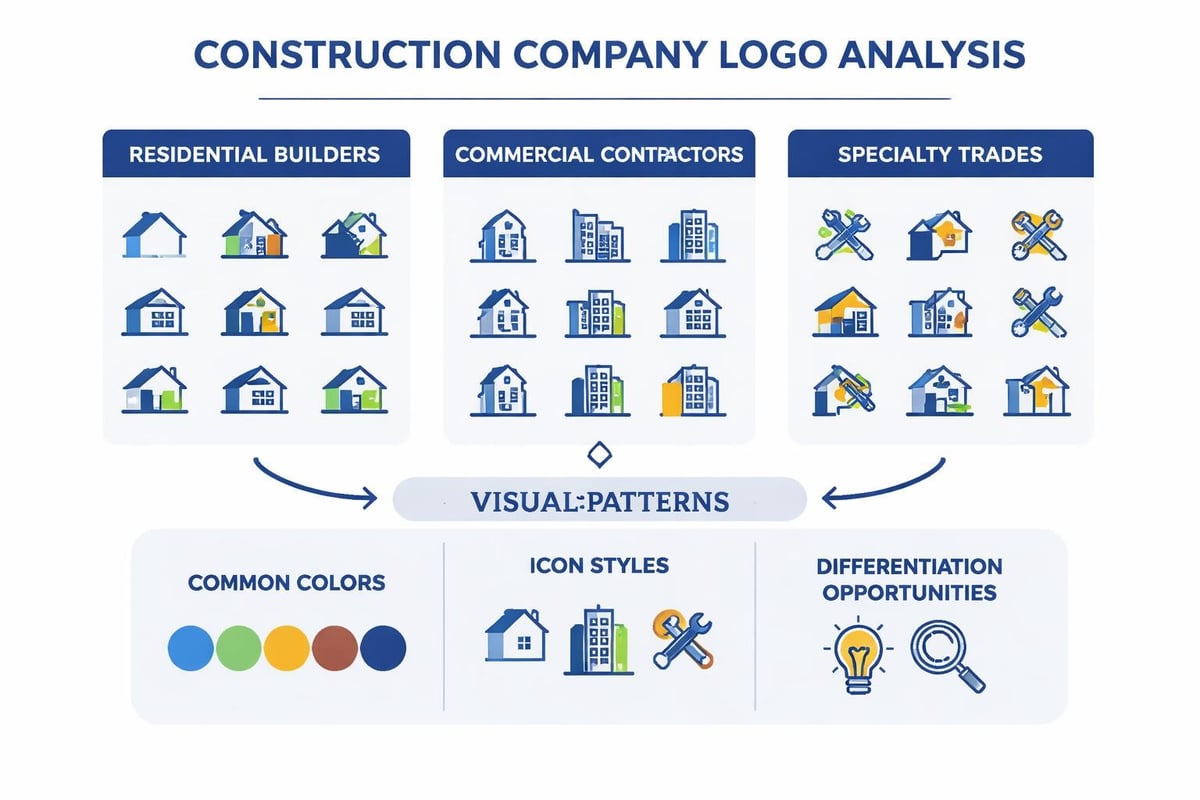
Defining Your Brand Positioning
Your logo design construction must reflect your unique value proposition. A boutique residential builder requires different visual communication than a large-scale commercial developer or specialized industrial contractor.
Consider these positioning factors:
- Project scale and type (residential, commercial, industrial)
- Geographic service area and local culture
- Price positioning (luxury, mid-market, value)
- Company heritage and experience level
- Specialty services or unique methodologies
Document your findings in a creative brief that guides the design process. This strategic foundation ensures your logo design construction aligns with business objectives rather than personal preferences alone.
Step 2: Select Industry-Relevant Symbolism
Construction logos traditionally incorporate symbols that immediately communicate industry association. However, effective logo design for construction businesses balances recognizable imagery with originality to avoid generic clichés.
Common construction symbols include buildings, tools, geometric shapes representing stability, and architectural elements. The challenge lies in using these elements in fresh combinations that feel both familiar and distinctive.
| Symbol Category | Examples | Brand Message |
|---|---|---|
| Structural | Beams, frames, foundations | Strength, stability |
| Tools | Hammers, wrenches, levels | Craftsmanship, precision |
| Architectural | Rooflines, arches, blueprints | Design expertise |
| Geometric | Triangles, hexagons, squares | Order, reliability |
| Abstract | Dynamic shapes, construction process | Innovation, progress |
The most successful construction logos often combine multiple symbolic layers. A geometric frame might incorporate tool elements, or an architectural silhouette might include negative space forming initials. This complexity adds depth while maintaining clarity.
Typography as Structural Element
Font selection plays a crucial role in logo design construction. Typography communicates as powerfully as symbols, with letterforms conveying stability, modernity, tradition, or innovation depending on their characteristics.
Construction-appropriate typography typically features:
- Strong, bold letterforms with good weight
- Sans-serif fonts for modern, clean aesthetics
- Slab serifs for traditional, established feel
- Custom lettering for unique differentiation
- Excellent legibility at all sizes
Avoid overly decorative fonts that compromise readability on job sites or in outdoor applications. Your typography should reinforce rather than compete with symbolic elements in your logo design construction.
Step 3: Implement Grid-Based Construction
Professional logo design construction employs geometric grids that ensure mathematical precision and visual harmony. This technical approach creates logos that feel inherently balanced even when viewers can't articulate why.
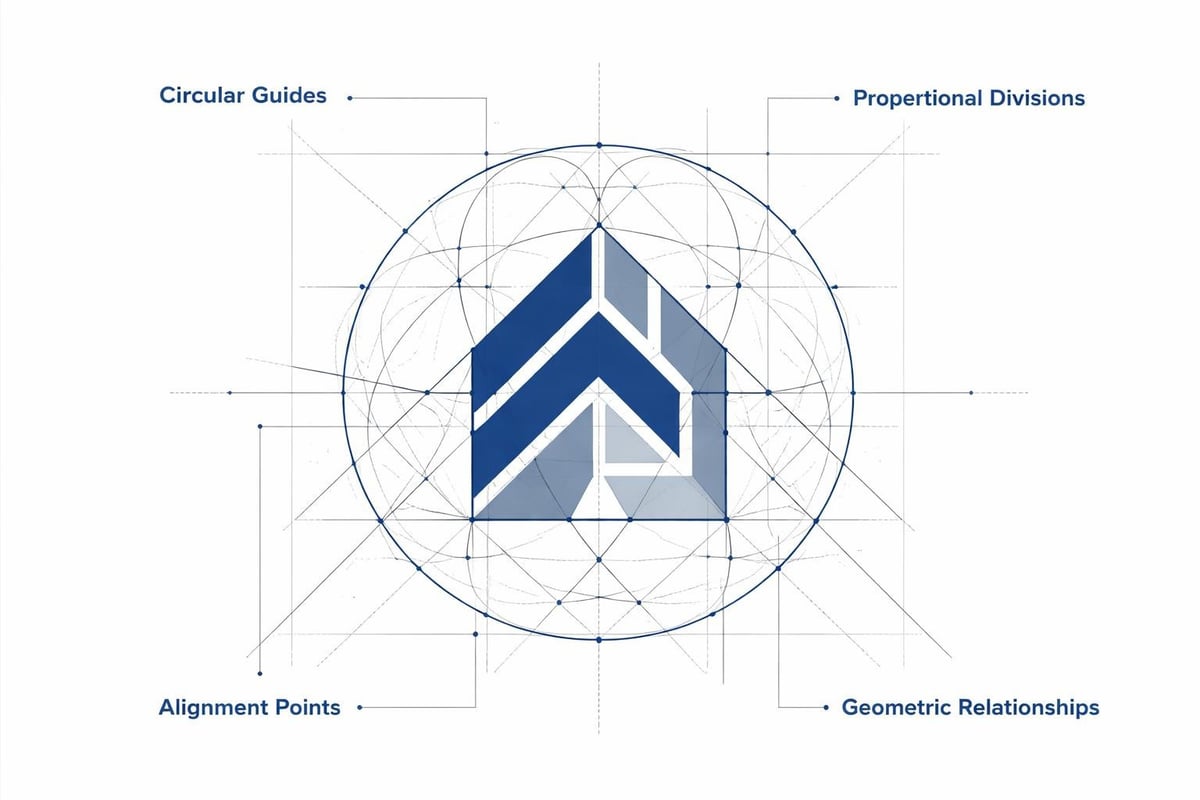
Begin with circles, squares, and proportional divisions that establish relationships between elements. Major design software includes grid tools, but many designers create custom grids specific to each project's requirements. The grid becomes your architectural blueprint for logo construction.
Creating Your Construction Grid
Start with a primary shape that reflects your brand positioning. Circles suggest community and completeness, squares convey stability and trust, triangles communicate strength and aspiration. This foundational shape determines the grid structure for your entire logo design construction.
- Establish the base unit: Define a single measurement that becomes your proportional foundation
- Create primary divisions: Divide your canvas into equal sections using your base unit
- Add circular guides: Position circles at strategic intersections to guide curved elements
- Mark alignment points: Identify key positions where elements will anchor
- Test optical adjustments: Make visual corrections that improve perceived balance
The Durable Construction project demonstrates how systematic logo construction combines geometric precision with industry symbolism to create memorable brand identities.
Step 4: Choose Strategic Color Palettes
Color psychology significantly impacts how audiences perceive construction brands. Your color choices within the logo design construction process should reinforce brand attributes while ensuring practical versatility across applications.
Construction industry color trends favor earth tones, industrial metals, and bold primary colors. However, strategic differentiation sometimes requires challenging these conventions to stand out in saturated markets.
Construction color psychology:
- Blues: Trust, stability, professionalism
- Grays/Blacks: Sophistication, strength, modernity
- Oranges/Yellows: Energy, caution, visibility
- Greens: Sustainability, growth, environmental focus
- Reds: Power, urgency, bold confidence
Current construction logo design trends show increasing adoption of dual-color systems that pair traditional industry colors with unexpected accent colors for memorability.
Planning for Color Versatility
Your logo design construction must account for single-color applications from the start. Test your design in full color, single color, reversed (white on dark), and grayscale to ensure it maintains impact across all scenarios.
Create a color hierarchy that prioritizes which elements receive color treatment in limited-color applications. Your primary brand color should carry the heaviest visual weight, with secondary colors supporting rather than competing.
Step 5: Ensure Scalability and Application
A logo's technical construction determines its real-world performance. Professional logo design construction anticipates every application scenario, from favicon-sized digital uses to building-sized environmental graphics.
Test your logo at extreme sizes during development. If details disappear or elements blur together at small scales, simplify your construction. Conversely, if your logo feels empty or unimpressive at large scales, add subtle complexity that rewards close viewing.
Technical Specifications for Construction Logos
Professional logo delivery includes multiple file formats optimized for different use cases. Your logo design construction should produce clean vector files that scale infinitely without quality loss.
Essential logo file formats:
- Vector files (AI, EPS, SVG) for print and scaling
- High-resolution PNG with transparent background
- JPG variants for general digital use
- Favicon-sized versions for web applications
- Single-color versions for embroidery and engraving
Document minimum size specifications and clear space requirements. Construction logos often appear on vehicles, signage, and workwear where surrounding visual clutter threatens legibility. Protect your logo design construction with defined usage guidelines.
Step 6: Refine Through Iteration and Feedback
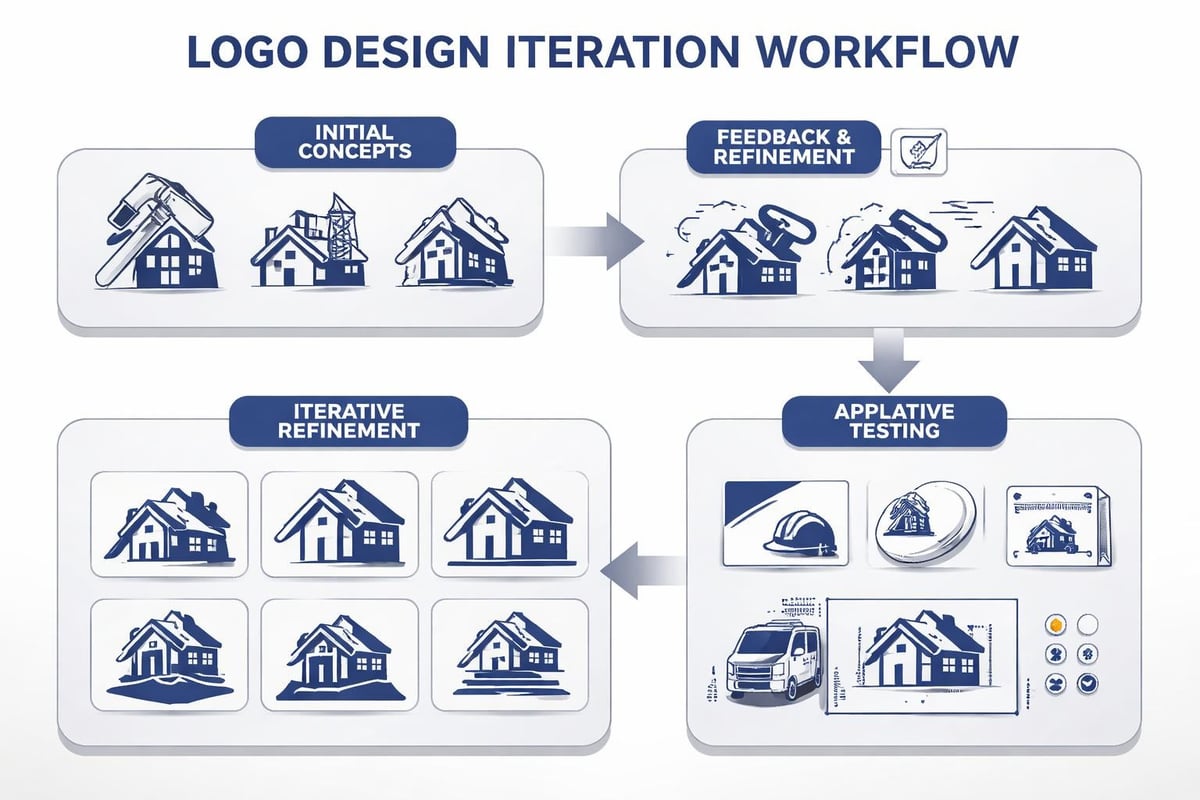
The logo design construction process involves multiple revision rounds that progressively refine concepts toward the optimal solution. Professional designers present multiple directions initially, then iterate the strongest concept through increasingly subtle refinements.
Present logos in realistic contexts rather than isolation. Mock up your construction logo on vehicles, hard hats, business cards, and websites so stakeholders evaluate practical performance rather than abstract aesthetics. This contextual presentation reveals how your logo design construction performs in the real world.
Gathering Meaningful Feedback
Not all feedback improves logos. Guide stakeholders toward useful input by asking specific questions about how the logo communicates brand attributes rather than soliciting personal aesthetic preferences.
Productive feedback questions include:
- Does this logo communicate strength and reliability?
- Would you trust this company with a major project?
- Is this logo memorable compared to competitors?
- Does it work equally well on digital and physical applications?
- What industry does this logo suggest to you?
Filter feedback through your strategic brief. Changes that contradict your positioning research or compromise technical performance should be rejected regardless of who suggests them. Your expertise in logo design construction guides these decisions.
Advanced Logo Design Construction Techniques
Beyond foundational principles, advanced techniques elevate logo design construction from competent to exceptional. These approaches require deeper technical skill but produce logos with enhanced sophistication and longevity.
Optical Adjustments and Visual Balance
Mathematical precision doesn't always equal visual perfection. Experienced designers make optical adjustments that override geometric accuracy to achieve perceived balance. Circular elements often extend slightly beyond alignment guides because human eyes perceive perfect mathematical circles as too small.
Typography requires similar optical corrections. Letters with pointed tops (A, V) typically extend above the baseline to appear equal height with flat-topped letters. In logo design construction, these micro-adjustments separate amateur work from professional excellence.
The principles behind professional branding extend beyond individual logo creation to encompass complete visual systems that maintain consistency across all touchpoints.
Negative Space Utilization
Sophisticated logo design construction leverages negative space to add meaning layers without increasing visual complexity. The space between and around elements can form secondary images or letterforms that reward careful observation.
Construction logos particularly benefit from negative space techniques that suggest structural concepts. Gaps between building elements might form tool shapes, or the space around a geometric construction might spell company initials.
Common Logo Design Construction Mistakes
Understanding what to avoid proves as valuable as knowing what to pursue. Construction logo design pitfalls often stem from prioritizing trends over strategy or complexity over clarity.
Frequent construction logo mistakes:
- Overusing industry clichés without differentiation
- Creating overly complex designs that fail at small sizes
- Choosing trendy styles that quickly feel dated
- Ignoring practical application requirements
- Designing only for digital without considering physical uses
- Following personal preferences over strategic positioning
The temptation to include everything (company name, tagline, multiple symbols, many colors) creates cluttered logos that communicate nothing effectively. Restraint and focus strengthen logo design construction more than addition.
Avoiding Template Traps
Free logo makers and templates offer quick solutions but rarely produce distinctive results appropriate for professional construction businesses. These tools generate generic combinations that hundreds of other companies might use, undermining your uniqueness.
Professional logo design construction requires custom development tailored to your specific positioning, market, and applications. The investment in professional logo design services pays returns through stronger market differentiation and enhanced brand equity.
Testing and Validation Strategies
Before finalizing your logo design construction, systematic testing ensures it performs across all required scenarios. Create a comprehensive testing checklist that evaluates technical, practical, and strategic criteria.
| Test Category | Evaluation Criteria | Pass/Fail Threshold |
|---|---|---|
| Scalability | Clarity at 0.5" width | All elements legible |
| Color Modes | Works in full color, single color, reversed | Equal impact in all modes |
| Applications | Effective on digital, print, apparel, signage | Versatile across mediums |
| Memorability | Distinctive after brief viewing | Recalled without reference |
| Relevance | Communicates construction industry | Immediately recognizable sector |
Test with actual target audience members, not just internal stakeholders. Show your logo briefly among competitor logos and measure which ones viewers remember. Strong logo design construction produces high recall rates even with minimal exposure.
Real-World Application Testing
Mock up your logo on actual business materials and photographed scenarios. See how it appears on work trucks driving past, on business cards handed across tables, on hard hats at job sites. Digital mockups help, but physical prototypes reveal performance truths that screens hide.
Print your logo at actual size on various materials and substrates. How does it look embroidered on work shirts? Vinyl-cut on vehicle doors? Engraved on metal? Each application method reveals whether your logo design construction accommodates production realities.
Implementing Your Construction Logo System
A complete logo system extends beyond the primary mark to include variations, supporting elements, and usage guidelines. Professional logo design construction delivers comprehensive brand assets that empower consistent implementation.
Complete logo package components:
- Primary horizontal logo version
- Stacked vertical alternative
- Icon-only mark for small applications
- Text-only lockup for specific contexts
- Clear space and minimum size specifications
- Approved color combinations and variations
- Usage guidelines with do's and don'ts
Document every specification in a brand guidelines document that anyone implementing your logo can reference. Clear standards prevent well-intentioned but damaging logo modifications that dilute brand consistency.
The graphic design services that create your logo should also develop these supporting materials, ensuring cohesive visual systems rather than isolated logo files.
Long-Term Logo Performance
Consider your logo's longevity during the design construction phase. While some businesses rebrand frequently, construction companies benefit from stable visual identities that build recognition over decades. Your logo should feel current without chasing fleeting trends.
Best practices in logo design emphasize timeless qualities that transcend temporary style movements. Classic geometric construction, restrained color palettes, and clear symbolism create logos that age gracefully rather than feeling dated within years.
Study construction companies with enduring logos. What qualities enable their continued effectiveness? How have they maintained relevance while competitors rebrand repeatedly? These insights inform logo design construction decisions that prioritize longevity.
Emerging Technologies in Logo Design
Advanced techniques continue evolving logo design construction methodologies. While fundamental principles remain constant, new tools and approaches expand creative possibilities and technical precision.
Parametric design systems allow designers to establish rule-based logo construction frameworks that generate variations within defined parameters. These systems prove particularly valuable for construction companies needing multiple subsidiary brand identities that maintain family resemblance.
Research into generative logo design explores how artificial intelligence might assist logo creation, though human strategic thinking and creative judgment remain irreplaceable in professional branding work.
Digital-First Construction Considerations
While construction remains a physical industry, digital touchpoints increasingly dominate customer interactions. Your logo design construction must prioritize digital performance alongside traditional applications.
Animated logo versions bring motion to digital contexts like websites and video content. Plan for animation potential during static logo construction by creating elements that can move independently while maintaining cohesion. Subtle animation adds polish without requiring complete logo redesign.
Consider how your logo appears as a social media profile image, website favicon, and mobile app icon. These small, often square contexts demand simplified versions that preserve brand recognition despite severe size and format constraints.
Mastering logo design construction for construction companies requires balancing industry expectations with strategic differentiation, technical precision with creative expression, and immediate impact with long-term versatility. By following systematic design processes grounded in research, geometry, and testing, you build logos that work as foundations for comprehensive brand identities. Whether you're establishing a new construction business or refreshing an existing brand, Cam Gomersall Design brings over 10 years of experience creating distinctive logos and comprehensive brand strategies that help construction companies stand out, build trust, and grow their businesses in competitive markets.